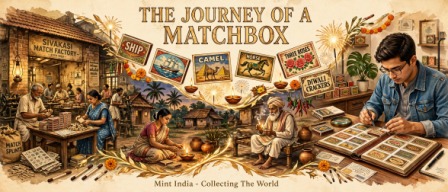
Blog Title: THE JOURNEY OF A MATCHBOX to PHILLUMENIST.
The Smallest Box That Lit Up The Whole From a tiny wooden stick to a collector's treasure. Discover the 200-year journey of the matchbox - labels, brands, and rare Indian matchboxes. Only on mintindia . One Matchstick, A Thousand Stories You have seen it a thousand times. On a kitchen shelf. In your grandfather's pocket. Near a diya during Diwali. A small box. 50 paise. 40 tiny sticks inside. You strike one. Chhss... And fire is born. But have you ever thought - this small box has a journey bigger than any big invention? Today, let us follow the journey of one matchbox.
1. BIRTH: When Man Wanted Fire In His Pocket Thousands of years ago, man had to rub stones to make fire. It took hours. Then in 1826, a man in England named John Walker made the first friction match. You rub it, and it lights! People laughed at him. They said, "Who will buy fire in a box?"But in 1840, matchboxes started selling all over Europe. Then they came to India.In India, matchboxes became a revolution. For the first time, a poor man, a farmer, a mother in a village - everyone could carry fire in their pocket for just 1 paisa.
2. THE GOLDEN AGE: When Matchbox Became Art This is the most beautiful part of the journey . In 1900 to 1990, India had more than 500 matchbox factories. Most of them were in Sivakasi, Tamil Nadu - the Matchbox Capital of India. And every factory wanted its box to look different. So they started printing beautiful labels on the box. Look at these famous Indian matchbox labels: Ship Brand: A big ship sailing on the sea-Camel Brand: A camel walking in the desert Three Roses: Three red roses Horse Brand: A running horse Elephant Brand: A big elephant Children did not collect the box. They collected the label. They would peel the label, paste it in a notebook, and trade it with friends - "I will give you 2 Horse for 1 Ship."That was India's first collecting hobby. Before coins, before stamps, children were collecting matchbox labels! In foreign countries, this hobby has a special name – Phillumeny . A person who collects matchbox labels is called a PHILLUMENIST.
3. The Journey: From Kitchen To The World Think about one matchbox in 1970.It is made in Sivakasi. It travels in a truck to Kolkata. A shopkeeper in Contai buys 100 boxes. A mother buys one box for 10 paise. That one box lights: Morning chulha for cooking Evening diya for puja A bidi for grandfather A candle during load-shedding Crackers during Diwali One box, 40 sticks, 40 small moments of light. Then the box becomes empty. Most people throw it away. But one child picks it up. He looks at the label. It is a rare label - a label that was printed only for 1 month for a festival. He keeps it. He puts it in his book.That empty box, which was worth 10 paise, becomes priceless 50 years later.
4. The Lost Years: Forgotten And Thrown Away Then came the gas lighter. Then came the electric stove. Then came the matchbox-free kitchen. Matchbox factories started closing. From 500 factories, only a few remained. Millions of beautiful labels were lost. People threw away old boxes. Old notebooks with labels were used as raddi paper. But in Europe and Japan, collectors were paying thousands of rupees for one rare Indian label. Because they understood - Indian matchbox labels are the most colourful, most artistic labels in the whole world.
5. Rediscovery: In The Hands of a Collector Today, if you open your grandfather's old trunk, you might find a tin box full of matchbox labels. Do not throw it away. Check them: Is there a label with a Ship, Aeroplane, or Taj Mahal ? Is there a label with English and Hindi both? Is there a label that says "Made in Sivakasi"?If yes, you are holding a treasure. A true collector never looks at the matchbox. He looks at the label, the colour, the printing mistake, the brand story. Every label has a story. Some labels were printed for a wedding. Some for Independence Day. Some for a movie - like Sholay or Mughal-e-Azam. Those are the rarest."A Coin Tells The Story of a King. A Stamp Tells The Story of a Country. But A Matchbox Label Tells The Story of a Common Man."
Thank you for reading our blog
THE JOURNEY OF A MATCHBOX